Keragon
Revolutionizing healthcare automation with Keragon
Keragon is a groundbreaking no-code automation platform specifically designed for the healthcare industry.
Web DevelopmentAPI Integrations and Support
An appointment-booking platform built to cut hospital waiting queues. Designed and built from scratch in partnership with ORCO.
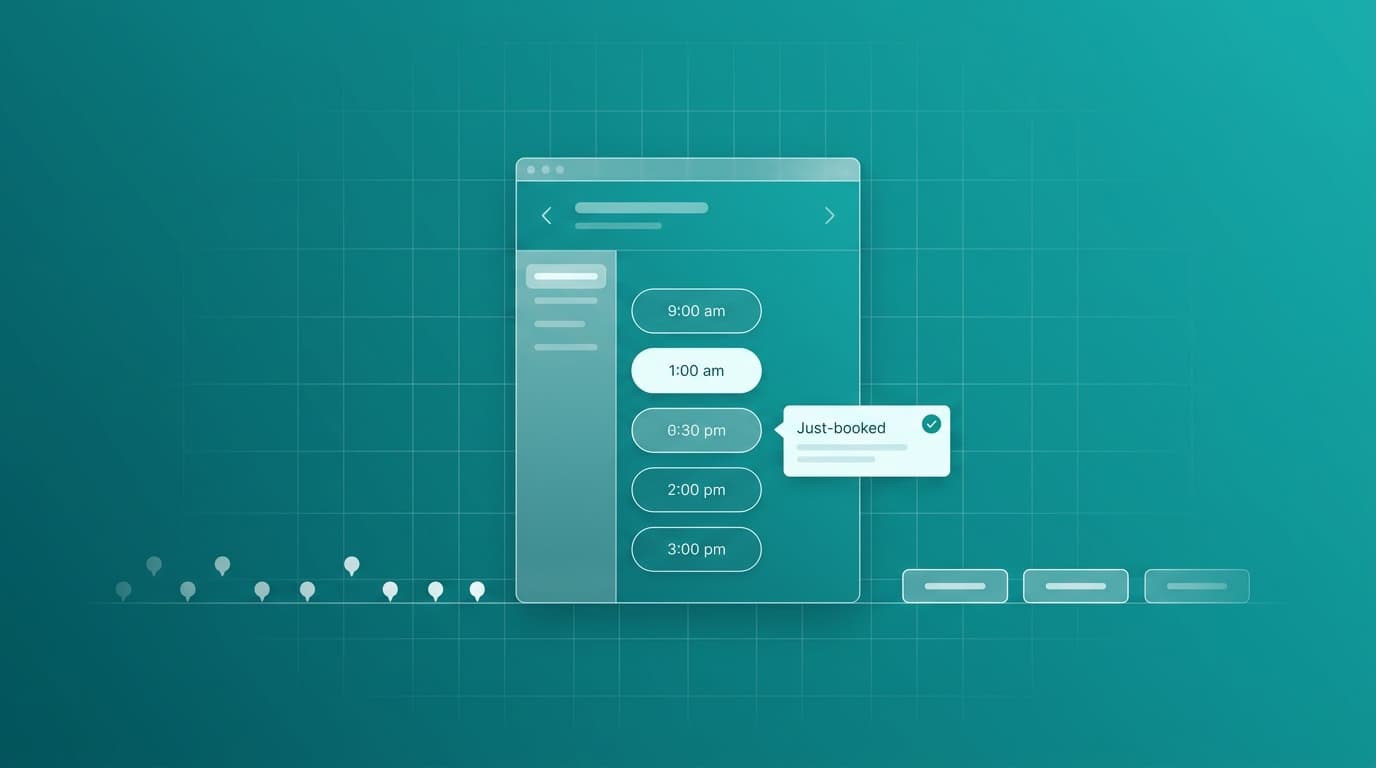
ORCO is an IT firm that has been writing software for the Greek healthcare sector since 1979. When they set out to ship RDV+, an appointment-booking platform aimed at cutting the waiting queues that show up daily at hospitals and clinics, they kept the backend in-house and asked us to design and build the entire frontend from scratch.
Greek public healthcare has a queue problem that predates any one app. In a recent survey of access barriers, 48% of people who needed a medical consultation in the past year reported difficulty getting one[1], most often citing the long waiting lists to book with a public-system physician. Phone-based scheduling, the default fallback, does not fix it. Industry research shows 23% of calls to medical practices go unanswered[2], and 61% of patients have skipped an appointment entirely because the scheduling process was too much hassle[3]. Meanwhile, 82% of patients say they prefer a provider who offers online scheduling over one with more availability[4].
The shape of the brief came from that gap. Patients have a phone in their pocket, an appointment to make, and a clinic reception line that will not pick up. RDV+ exists to replace that line with a screen.
ORCO had the appointment engine on the backend, built on a decade of prior experience in healthcare scheduling. We were asked to design and build the patient-facing surface from scratch: every screen, every form, every transition.
The constraint we set ourselves up front: keep the surface minimal. The audience is not an engineer with a clear mental model; it is a patient looking for the next available slot in a system they do not visit often. Density and jargon both fail that user. So does decision overload.
We landed on three principles and held the line.
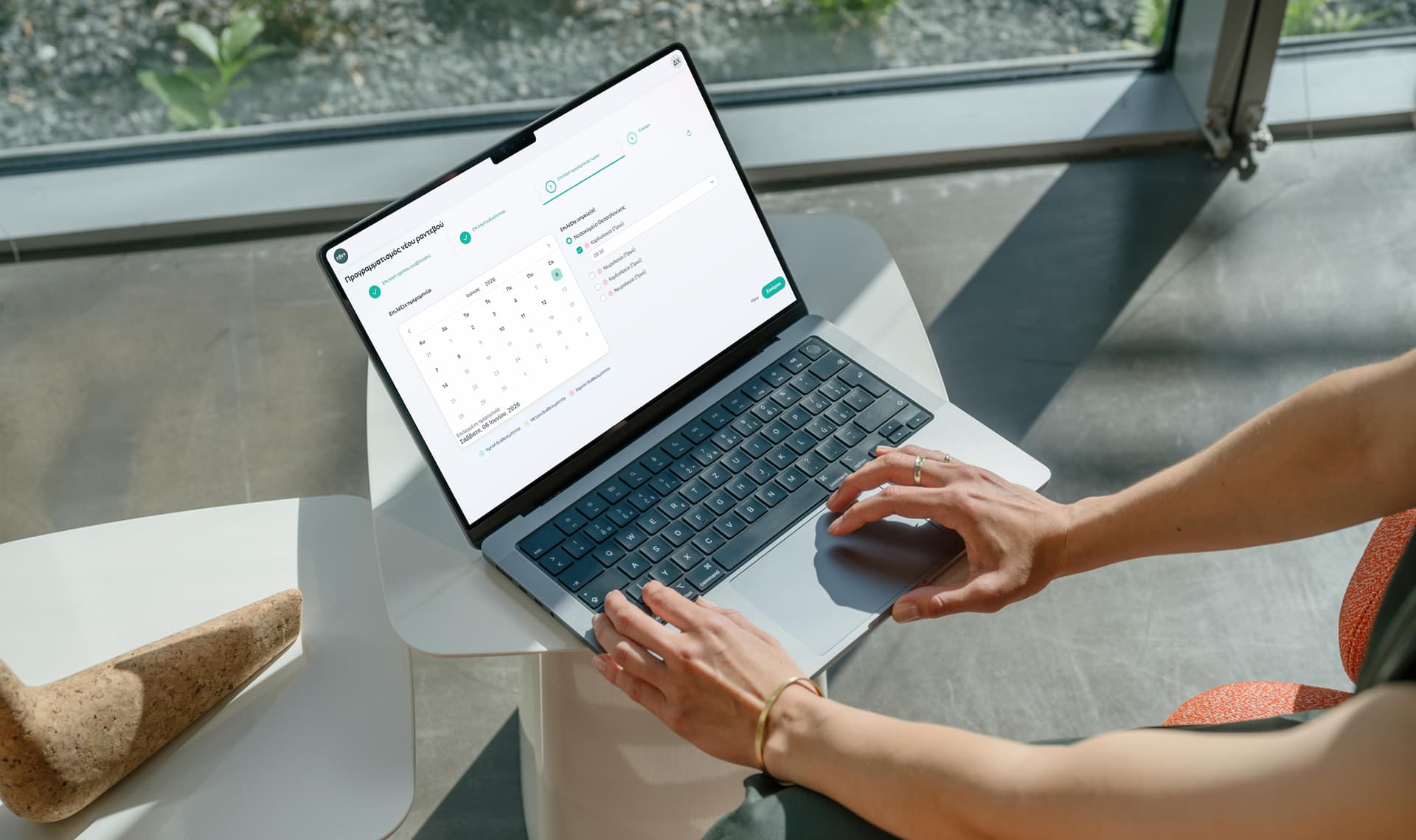
One question per step. A booking decomposes naturally into "where, who, when". We built the flow as a wizard with a stepper at the top, showing exactly where the user is and what comes next. Each step asks one thing: pick a hospital, narrow to a clinic, pick a specialty, pick a slot. Backwards navigation is always available; forward only when the current answer is valid.
Plain words over clinical labels. Field names, button copy, and error messages all use everyday Greek. Where a clinical term is unavoidable (specialty names, for instance), we surface it via dropdowns rather than free text so the patient picks from the system's vocabulary rather than guessing at it.
Feedback at every action. Loading states, success confirmations, and error toasts on every async call. A patient who taps "book" and sees a spinner knows the system heard them; one who taps and sees nothing assumes it did not.
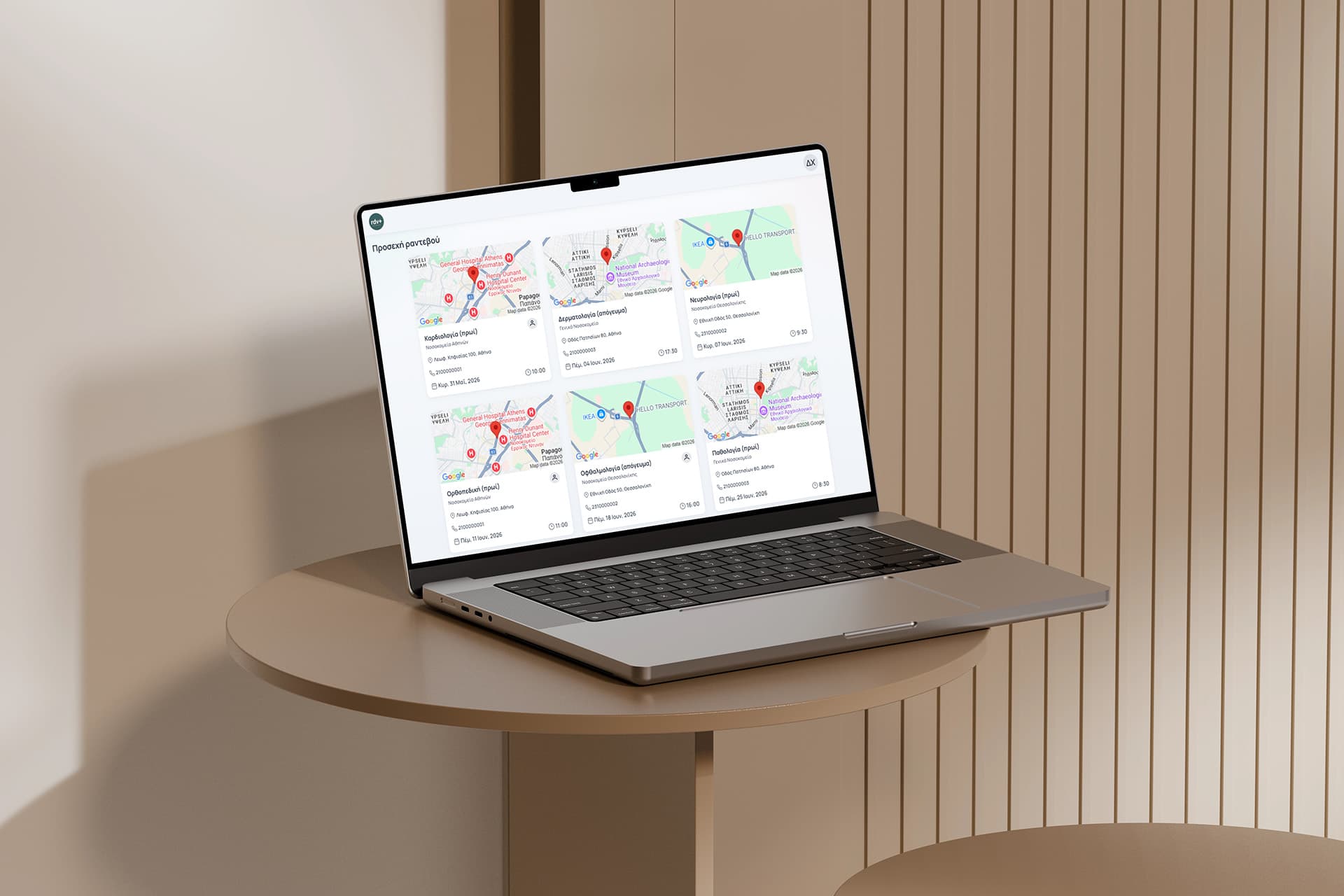
The application covers the full booking lifecycle. Patients land on a dashboard, sign in or activate a freshly registered account, search for the hospital or clinic they need, and walk through the booking wizard.
Once booked, an appointment lives in a history view where the patient can review, modify, or cancel it. A contacts module lets users keep recurring patient details on file (their own and any dependents they book for) so the second appointment is two screens instead of five. A map view helps locate hospitals and clinics geographically rather than scrolling through a flat list. Greek localization runs the full length of the application.
The frontend is an Angular application. The backend, including the appointment engine itself, was designed and built by ORCO. Our scope was strictly the experience layer.
RDV+ launched with coverage from two of the larger Greek outlets covering technology and current affairs, Voria and Lifo, both highlighting the application's role in reducing queues at healthcare and public-service offices. The ORCO team has continued to evolve the codebase since.
Pavi E., Konstantakopoulou O. et al. Barriers in Access to Healthcare Services in Greece Post-COVID-19: Persisting Challenges for Health Policy. Healthcare (PMC), 2024. pmc.ncbi.nlm.nih.gov/PMC12346359
Talkdesk. Healthcare Industry Report 2025. Talkdesk Research. talkdesk.com
Notable Health. State of Automation in Healthcare, 2022 Patient Survey. November 2022. businesswire.com
Healthgrades / STAX Inc. Consumer Perceptions of Scheduling Appointments with Physicians Online. healthgrades.com
KDL felt less like an external vendor and more like a true extension of our own team. Not only did they build a high-performing application, but they also delivered it on time and with outstanding code quality. They were responsive to feedback, agile in their execution, and consistently went above and beyond to ensure the project's success.
Vasileios Tzevelekis
CEO, ORCO